Earthworks design.

By Andy Williams.

From the very beginning of planning this site, I knew we’d need to do some serious earth moving. The site is intermittently wet because the subsoil is clay, so when it rains heavily there’s nowhere for the water to go once the topsoil is saturated. We’ll be improving this by increasing the organic matter in the soil by planned grazing, but it can only achieve so much. We plan to plant fruit and nut trees, which struggle with consistently waterlogged roots for the most part. The solution is a permaculture classic, almost a cliche really: swales.

A swale is a ditch dug along the line of contour, with the removed topsoil forming a berm on the downhill side of the ditch. Their purpose is usually to catch overland water flow and hold it, so it can be absorbed into the ground instead of running off the property. In dry climates they’re fantastic, and allow people to grow tree varieties without irrigation that would be impossible otherwise. Of course nobody would describe the north of Scotland as a dry climate, but here they’ll serve another purpose. The berm will allow us to plant trees in soil that’s higher above the water table, giving them a better chance. We’ll be able to plant other, smaller, water loving shrubs like wax myrtle lower down the berm where the soil is wetter and other productive species like ramsons in the bottom of the swale ditch. We’ll be able to create really interesting, productive polycultures because of the different niches on different parts of the swale with differing amounts of moisture and shade. An often overlooked benefit of swales is that they effectively increase the acreage of land. If a piece of A4 paper is representative of an acre of land, imagine a sheet of corrugated card the same size. Now imagine pulling that corrugated card from each end to flatten it out. Free land! Of course swales aren’t dug at the same concentration as the ridges in corrugated card, but the principle still holds. The swales will of course infiltrate a great deal of moisture into the ground during rain, after all it’s what they’re generally used for, so even during dry summers we shouldn’t get water stressed trees and shrubs. Not bad for a glorified ditch eh?

Ponds, even small ones, have a positive effect on natural ecosystems. The same is true within diverse agricultural systems. They have a moderating effect on microclimate because of their thermal mass. They encourage natural biodiversity, for example frogs and toads, which feed on slugs. Who’s ever grown food in a damp climate without wishing there were fewer slugs? Ponds can also be used more directly for food production of meat such as ducks and geese, plants such as watercress and large ponds can be used for aquaculture of fish. Our swales will be designed to fill relatively small ponds, but they’ll still be useful. I have a niggling little plan in the back of my mind that integrates water culture with a greenhouse that should be interesting but that’s for a different blog, far in the future.

Swales, as I’ve already said, need to be dug perfectly on contour. Water shouldn’t flow along them but remain static until infiltrated. Careful levels need to be marked out before any digging begins. Earthworks permanently change the hydrology of any landscape and need to be carefully thought out. In the case of our top field, we need to establish the way the ground slopes before finalising any design. Just looking at a field is never accurate enough. We know it slopes generally to the north of course, but is that north with a bit of west, or east? The human eye just isn’t good at estimating slight changes in slope.

There are many ways of setting levels within landscape. A laser level is beautifully accurate, but is expensive. I tend to buy good quality tools but only if they’ll be used regularly, and once we’ve marked out the contours in the field we’re not likely to need one often enough to justify the cost. One cheap alternative is an ‘A’ frame level. It’s simple to make and reasonably accurate, but doesn’t work well going through undergrowth. At the moment the top field is bare, but we may well need to set some levels after the swales have been put in. For us, the best option is the bunyip or hose level.

At its most basic, it’s a length of clear hose clamped or taped to a wooden stake at each end. With the hose mostly filled with water, when the stakes are put side by side on a flat and level surface the water level in each end of the hose will be exactly the same. If that level is marked on both stakes and one of the stakes is moved up, the water will remain level but will now be below the mark on the stake. It will of course be above the level on the other stake, because that’s how water always behaves. If the hose is a long one and two people have a stake each, they can ascertain whether the stakes are at the same height even if they can’t see each other just by telling each other whether the water level in the hose is above or below the line. It’s beautifully simple, and cheap.

I built ours a little fancier. The hose must have no airlocks in it, or it’s just not accurate. Airlocks are difficult to eliminate in a thin diameter hose, so I used 25mm braided hose. The thicker diameter also eliminates a lot of drag on the inner surface of the pipe which also should increase accuracy. Instead of marks drawn on the stakes I cannibalised a pair of cheap tape measures and screwed a tape to each stake. Hose is somewhat flexible, so if it’s squashed at all it changes the internal volume. This could lead to two people trying to describe just how much above the line their water level is. With tape measures on the stakes you can use figures that actually mean something to both people, nice and accurate.

IMG_7730

We’ve had a bit of a play with it this afternoon, and it really does seem to work as well as the literature suggests. Tomorrow we’re going to survey the slopes in the top field and work out where the swales will run and the retention ponds will logically go. After years of study and planning, this is the start of the exciting stuff. As a bonus, there’s nothing quite like dragging a pipe full of water stuck to a couple of tape measures around a field, sticking in bamboo canes and waving your arms around, for entertaining your neighbouring farmers. Who knows, I might even crack out the new video camera!

The beast is done.

Just a quick update today. The weather is fantastic and there’s no wind so we’re doing as many outside jobs as possible that need still conditions.

This morning I pulled five of the stone slabs that form the back fence, including the intimidating one. It’s about 4 1/2 feet by 3 1/2 feet and three inches thick at its thinnest point. I dread to think what it weighs. You can see in the photo how much of it was buried, these fences really aren’t built to be taken down! IMG_7723.JPG

I’ve worked out a technique that uses my body weight to help lever it out of the clay, which makes an asset of being 19 stone, but it still hurts. I need them all out before next Friday, when the cement mixer arrives. A shed is going where these stones currently are and I need to do a lot of ground prep before then.

A nice comfrey bed (or taking the p*ss again).

By Andy Williams.

On a (literally) lighter note, we got the comfrey crowns in yesterday. Comfrey is an amazing plant. It used to be widely used as food, but is now considered potentially toxic so is no longer recommended for eating. Comfrey is attractive, producing flowers ranging from pink to blue. Bees love it. It’s easy to propagate, and is best known as a bioaccumulator. Comfrey roots are huge. The tap root grows down into the subsoil and brings up minerals into its above ground parts. Once established it can be cut several times a year without harm and the leaves either used as a green mulch, essentially a slow release fertiliser, added to compost heaps as an activator, fed to livestock, or made into comfrey tea for feeding plants. It’s easy to propagate, you just take sections of root and plant them. Most varieties self seed to the point of being invasive, but the Bocking 14 variety is sterile, making it more suitable for our uses. Eventually we aim to have it growing under all our fruit trees. It’ll provide good ground cover and can be cut a couple of times a year to feed the trees. No need for any synthetic fertilisers or barrowing materials around the farm, just a walk with a scythe-. This first patch though is to be used for a different purpose. We’re going to have a composting toilet between the veg garden and where the main greenhouse will eventually go. The toilet will have a diversion system for urine, which will go into a short soakaway. The comfrey has been planted either side of where the soakaway will go, to make use of that fertility and convert it into a useful resource. No urine puns from me! You’re welcome.


You don’t need a gym, you need a croft.

By Andy Williams

We all know what a fence looks like. It’s metal wire strung between wooden posts. Usually yes, but there are occasional local variations. In the slate producing areas of north Wales they’re often wire twisted around slate posts. It’s a clever use of what would have been a waste product, and they last a lot longer than virtually any wooden post would. Here in Caithness they have a different variation of a fence. Stone slabs are set upright, with about an inch overlap where they meet. That overlap means that each slab is supported by the slab to either side while supporting both of them at the same time. It’s impossible for any one slab to fall over. Either the whole fence stays up or the whole fence goes over. Caithness tends to be fairly windy, so it’s an excellent solution for livestock. Animals have a solid windbreak to get behind in bad weather. It doesn’t need maintaining like a hedge or fence does. Clever eh? Only one little problem. What if you need to move a solid stone fence?

We have one marking the outline of our back garden, which has stood for 80 years. Over time, the soil inside the garden has built up until the weight of it has slowly pushed the whole fence over at an angle. Its position also means we have to either climb over it or walk around it to get into what will be the veg garden. It’s time for it to go. Simple. Just dig a bit, lift a bit, move onto the next slab, right? In reality it’s not quite that easy, as we discovered yesterday. Every slab is sunk a good two feet into heavy clay soil that hangs onto the stone so well that we have to dig a trench the full depth of the slabs, then lift each out by brute force. They’re typically roughly three feet wide and five feet long, and solid Caithness stone. The real factor in shifting them comes from the thickness, which can vary a lot. The thinner ones I can move fairly easily. I’m not a small person, and after a few months of labouring on the croft I can generally get by. Some of them are three inches thick however, and moving them hurts! In a whole afternoon we only managed to lift out four of them. The way the stones lean into each other means they have to be taken out in order, you can’t just move up and down the row. The next two slabs are  skinny ones. Lovely. But the one after that is three and a half inches thick, and the widest in the whole row. I freely admit it intimidates me. Today my whole upper body aches. I’m giving myself until Monday to recover, then it’s back to the digging. Only thirty of them to go. Doddle. No, really!

The slabs actually have value and are sold second hand locally. We’re going to use them on site. We’re going to turn them into walkways to access the veg garden in wet weather. Barrowing compost, manure and soil amendments out, and harvested crops in, would normally compact the ground and make an awful mess after rain. Not in our garden. We’re having a wide stone pathway running every third bed. It adds functionality to the veg garden at no cost.

Forget the gym. The gym is for the weak. You want The Croft Plan. It’s like a gym, but you never go home. You live at the gym now. And you’ll never leave.


The polyamory of plants.

By Gabrielle Williams.

We brought with us from Yorkshire a motley mixture of plants in pots, numbering about 40, originally from our small back garden. These were herbs, such as oregano and mint, plus perennials including horseradish and ramsons, as well as small shrubs including Buddleia and currants. Also a few trees: rowan, apple, oak and yew. And Kim, our affectionately named pinus Koraiensis, which had served as our Yuletide decoration for 5 years. Between periods of active service, she lived in a large pot in the garden. The Korean pine puts on a new level of horizontal branch growth every year, making a delightful pyramid shape. It’s a productive edible nut variety, producing nuts after about 20-25 years. Handy!

For the last couple of years, Kim looked in desperate need to go into the ground, the upper branches becoming crowded and stunted. All together now: poor Kim! You’ll be relieved to know that one of the first things we did was to plant her into the wet and welcoming ground of Caithness. Sigh of relief all round. Even better, we’ve just introduced Kim to some new friends: the blueberries. In nature, a tree such as the pine will grow with an understory beneath it of other smaller plants which don’t compete with it for resources, such as light and food, forming a mutually beneficial relationship. Pine forests are naturally acidic, as is our field just now, and blueberries are acidophilic plants. In the future, we’ll also plant juniper under more Korean pine. A couple of years ago, during our walking holiday in the Cairngorms, we observed a natural polyculture of pine over juniper and raspberry. Why fight nature? I’d rather try to emulate an ecosystem that works.

Now Kim and friends are enjoying a peaceful retirement with a view of the loch and will become part of our view from the living room window and eventually provide us with nuts and fruit. Thanks, Kim.

IMG_7701.JPG

Taking the p*ss.

By Gabrielle Williams.

After a breakfast of porridge and a good slug of caffeine, I head outside for the first task of the day: pouring pee. I’m weird? You’re weird! We have an additional ‘water feature’ in our bathroom: a big yellow watering can. Jealous? Our trees have only been in the ground a few weeks and we’re keen to give them every possible assistance to grow well. Urine makes an excellent plant fertiliser, mixed 10/1 with water. It has the added advantage of acting as a deterrent to deer, who would love to nibble on those tender buds and shoots. There’s not a lot of deer pressure in our area of Caithness, but it makes sense to be cautious. Those beasts can jump and our fencing is woeful at the moment. It lets the animals know that humans are here, plus it’s free and plentiful, so the price is right (urine the money! I’m not even sorry). Ideally, avoid pee which contains oestrogen from contraceptives, or any other pharmaceuticals, as this can contaminate your soil. A morning walk round the saplings is a good way to keep a close eye on their progress too and become aware quickly of any issues. Today, I noticed that rodents have been rearranging and nibbling on some of the mulch, so that’s something we’ll be addressing very soon and will be detailed in a future post. A pee days!

IMG_7704.JPG

Call that a mulch? This is a mulch.

By Andy Williams.


Creeping buttercup is hard to eradicate and what will be our veg garden is overrun with it. We have a plan to sheet mulch large areas with black plastic until next year, then grow in those areas while the areas we’ve grown in this year are mulched for a year. As part of designing the system to be future proof, we’re putting in metre wide paths every third bed. Theoretically they should make wheelchair access easier should it ever be needed, but getting those paths clear of buttercup was posing an interesting problem. Today while clearing rubbish we came across an area that seemed suspiciously garden fork proof, and we came across paving four inches down. Pathway problem solved, and we’ll be able to take wheelbarrows into the veg garden even in wet conditions. Buttercup is tough, eh? Let’s see how it handles being buried under four inches of Caithness stone. IMG_7688.JPG

In pursuit of the classics.

By Andy Williams.


When we bought the croft we found a big burned mound behind the house. When we dug into it we found that at some point, a large volume of someone’s personal belongings had been piled up and set fire to. When it was pretty well ablaze, a mattress had been thrown on top, partially smothering the fire so the things at the bottom didn’t completely burn away. Over time the scorched mattress grew moss, grass and buttercup all over it. Since we moved in we’ve occasionally spent an hour sifting through it all.

Yesterday we raked out another section of The Amazing Pile Of Partially Burned Crap. We sorted it as always into piles of rubbish, scrap metal, paper, ash and wood. We unearthed several rotten and partially burned bags of books which got added to the ‘will burn’ pile. Some people may not know this, but when you heat a book the first thing to burn away is the binding glue. It takes quite a lot longer for the pages to begin to burn. The books, paper and wood were all put into a wheelbarrow ready for a fire next week, when it’s not as windy. I put a big bit of chipboard on top to hold it all down, job done. Unfortunately, while we were out shopping, the chipboard blew off the wheelbarrow. Pages everybloodywhere. It’s not every day you can say you spent twenty minutes chasing Charles Dickens around your field.

Our minimal tillage approach.

By Andy Williams.


Until relatively recently, the rotovator was king. If you wanted to establish a vegetable plot you bought, rented or borrowed a rotovator and ground the top foot of soil into a beautiful soft seed bed that you could sink your bare hand into up to your wrist. One of my earliest memories is of watching my grandfather wrestling a machine over his veg plot every spring, and he grew amazing crops. A rotovator can cause issues however. In soil with a high percentage of clay the rotating blades of the machine can have a ‘smearing’ effect at the bottom of the soil being mixed, producing an impenetrable layer. This can hold water in the topsoil rather than letting it percolate down into the subsoil, causing waterlogging. Many plant roots cannot penetrate this compacted layer, causing poor growth and adversely affecting yield. Every time the soil is worked this way the problem becomes even worse.

In recent years, our understanding of soil structure and biology has changed fundamentally. Soil is a living ecosystem, not merely a medium to hold plant roots. Soil in a natural ecosystem forms in distinct layers. Dead plant matter and animal manures are deposited on the surface. Insects, weather and bacteria get to work on it, breaking it down. Worms take some of it down into the lower layers, increasing the organic matter in the soil. Organic matter increases soil’s water holding capacity and provides food for the microbiology living below the surface. Other worms bring up particles from the mineral rich subsoil. As plants are grazed by animals or have the above ground parts harvested by humans, a corresponding amount of the plant’s roots are shed by the plant. The shed roots biodegrade, leaving channels of organic matter through the soil, improving aeration and fertility. The combined effect of these actions creates a healthy soil with a complex structure that supports billions of bacteria and archea. Take a handful of soil in your hand and you’re holding an entire world, teeming with life. The different species of archea and bacteria feed on the organic matter, gels, and each other to form an incredibly complex food web.

In addition to the creatures and plants in soil there is of course a third kingdom, that of fungi, and the fungal interactions in soil are truly remarkable. Fungi form symbiotic relationships with many plant roots. They send out filaments through the soil over huge distances, harvesting resources over a much greater volume of soil than plant roots alone could manage. The fungi exchange these nutrients with plants in exchange for simple sugars, since they are unable to photosynthesise themselves. A plant root is composed of living cells, it takes significant resources to grow and maintain roots. Fungi, on the other hand, send cells out along tubes, the hyphae, that are not actually living tissue in the way a plant root is. Once the fungus is done with that strand it withdraws the living cells back from the tip, along the hyphae, into itself. This is how fungi are able to collect resources much more efficiently than plants alone can. It’s an elegant symbiosis, benefiting both. Fungal hyphae have been observed moving nutrients over 50 metres from their source, and they are now understood to actually communicate with plants, allowing plants of different species to communicate with each other over significant distances. The fungal soil web has been referred to as the internet of the soil for that reason.

The bacteria, archea, insects and worms can feed on the hyphae , and the fungi have mechanisms for killing and harvesting the archea and bacteria. It’s this web, of these billions of creatures feeding, reproducing, dying, interacting with plant tissue and fungal hyphae and being acted upon in turn that produces the natural fertility of living soil.

This is an extremely simplistic explanation of the complex interactions in soil of course. I’ve barely scratched the surface here and research is ongoing. Recent research by Dr Elaine Ingham has found that virtually every soil she has tested contains enough fertility to last for billions of years. The problem is that the fertility is bound up in a way that is not accessible to plants. To make that fertility available takes living processes. Put simply, it’s the living soil web that makes that fertility available to plants in a form they can use. If the right soil life is encouraged, and we have the technology to do this, then we need never use fertilisers ever again. In terms of agriculture, this is a game changer. Still think soil is just dirt? There are recorded lectures by Dr Ingham available on Youtube and I highly recommend them.

What does all this have to do with establishing a veg garden? Even today most experienced gardeners advocate either rototilling or double digging every spring to prepare the growing beds. This smashes apart the delicate soil structure, mixes the layers and destroys the fungal hyphae. It brings up weed seeds from the lower layers. It’s done with the best of intentions of course, to decompact the soil and introduce air into the soil. Recently dug over soil has a beautiful feel, evenly textured and soft. The trouble is that such soil exposed to the elements quickly settles. With the life that gives soil its natural structure destroyed, there’s nothing to hold those air spaces open. Rain washes the particles down into the air spaces and the soil becomes more compacted than it was before it was broken up. It’s a short term solution that is counterproductive in the long term. This is why it needs double digging every spring.

What are the other options then, if the conventionally accepted method has been proven to be destructive? Welcome to no dig. In our context we have serious compaction in the area we want our veg system. Livestock has been kept there for so long that while the soil seems extremely fertile, the action of animal hooves over and over has compacted the ground badly. That compaction has allowed creeping buttercup to dominate the area, and creeping buttercup seeds remain viable a long time. Excavated seeds have been sprouted after 80 years buried deep in the soil. Rotovating would continually bring viable seeds to the surface, it’s one reason it’s so hard to eradicate. Without at least knocking back the buttercup however anything we plant will just get choked out. No dig is not only a good idea for the reasons I’ve already explained, it’s vital on this site.

In a true no dig bed the soil is never dug, just as it sounds. Vegetables are cut at ground level and the roots are left in the ground to add organic matter. Root vegetables are typically just pulled out, which is easy because the soil is soft, or if it’s particularly dry they’re sometimes loosened with a fork to make it easier. Compost and other soil amendments are spread on the soil surface and left for the soil life to incorporate. The beds are never stepped on so they don’t get compacted. Between crops and during the winter the soil is never left bare, it’s mulched. In drier climates than the UK the beds can be mulched with organic matter like straw, even while crops are growing. The mulch is broken down by the soil life and acts as a slow release fertiliser while protecting the soil from erosion and drying out.

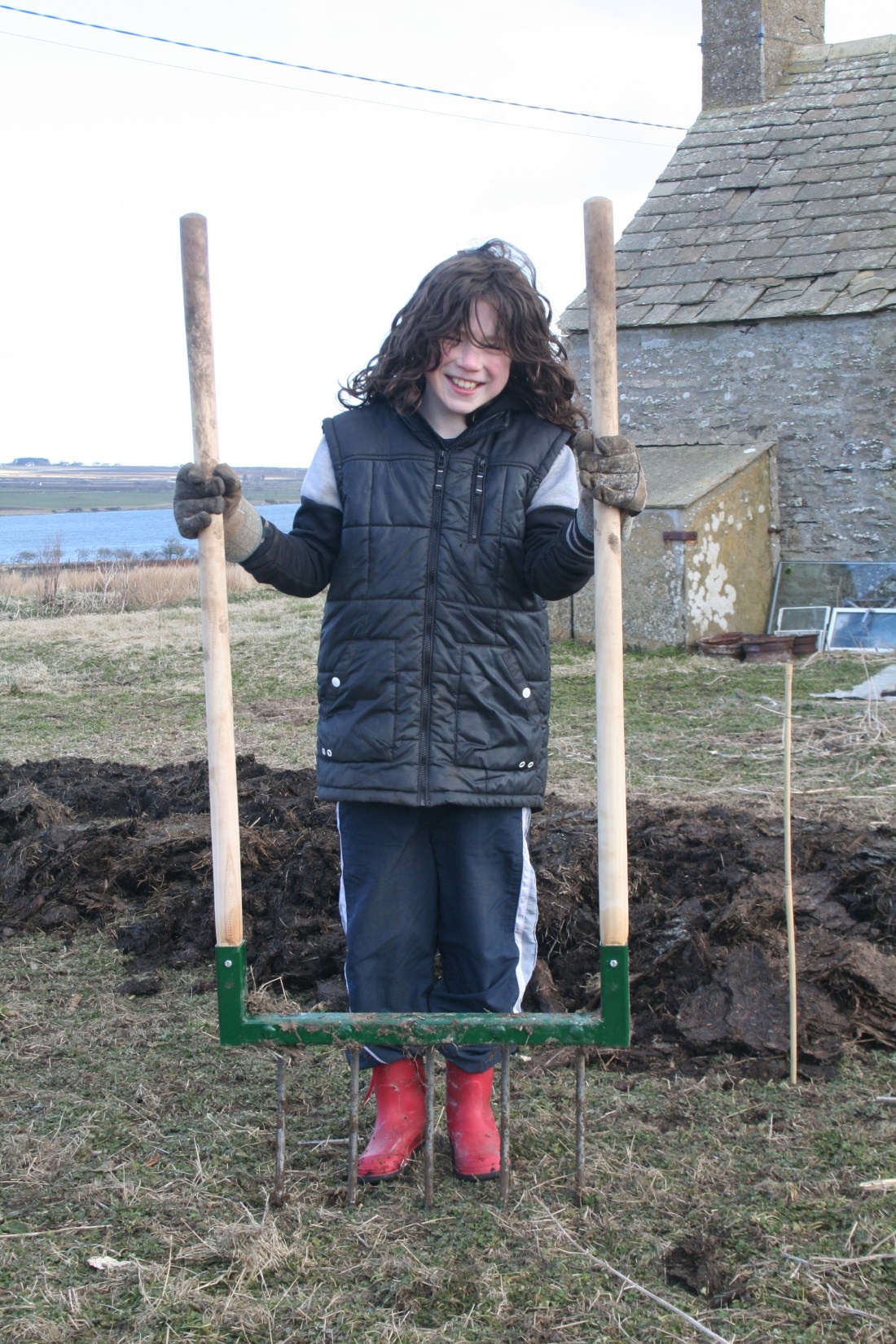
In the UK organic mulches are habitat for slugs so are best avoided. Here mulches are typically plastic sheeting that’s tough and lasts for many years, though paper and cardboard are popular with purists who dislike using plastics. Many people adopt something of a compromise, minimal tillage. For high turnover commercial systems the beds need to be replanted quickly, often the same day. Tools exist that till just the top inch or so of the bed, so produce minimal disturbance. In our context, where the soil is very compacted, we’re compromising in order to loosen and aerate the soil but without destroying the structure. This can be done using natural processes if you don’t mind waiting longer than we’re prepared to. The simplest technique is applying a thick layer of manure or other rich organic matter, covering it with mulch and letting nature take its course. Another way would be to plant a closely spaced crop of something with a deep taproot like daikon radish and leave it for a season. We want to be able to grow at least some crops this year, so we’ve invested in a tool that is perfect for our croft. Meet the broadfork.IMG_7676.JPG

This is a two handed fork with deep tines, that are shaped into a parabolic curve rather than the straight tines on a conventional garden fork. To use you stand on the crossbar and wiggle the handles a little to force the tines into the ground. Then you lean back using your body weight to pull the handles toward you. The tines lift the soil a little but don’t destroy the structure. You lift the fork clear of the soil, move it back 8 inches or so and repeat. Keep going until you run out of bed. Our soil was so compacted we had to broadfork it in both directions, but afterwards we could really see the difference. The area that’s been worked is raised and feels springy underfoot.IMG_7649.JPG

Most people who use a broadfork report that after a few years of using it for bed preparation the soil is soft and loose to the full depth of the tines and it’s no longer needed.

We’ve laid out our beds to be 30 inches wide. Many of the tools developed for intensive vegetable production using minimum tillage have been designed for beds of this width and it seems sensible to future proof the layout by going with this width from the start. All of our beds will be 10 metres long so we can have all plastic mulches, weed control fabrics and fleece bed covers the same length. It also makes planning crop rotations and growing the right number of transplants simpler.

After broadforking we’ve added rock dust as a soil amendment and a broad spectrum mycorrhizal inoculant to introduce the beneficial fungi, and topped each bed with a foot of aged goat manure. Finally we’ve leveled the manure and covered each bed with black plastic sheet mulch. We’ll leave them covered until we’re ready to plant. This will warm the soil and any viable seeds in the manure will sprout and die without access to the light. The manure is full of worms. They will hopefully thrive under the mulch, aerating the soil and mixing the rock dust and manure with the aerated soil beneath. With the beds as rich in nutrients as ours are this year only heavy feeding plants will likely do well, but we’ll also be sheet mulching the remaining area and leaving it in place until next spring, by which time the creeping buttercup should be dead or nearly so. This will give us some manured beds and some less fertile, an excellent start to introducing a planned crop rotation.

Everything starts somewhere.

By Andy Williams.


In September 2017, my wife and I bought a croft in the Highlands. As house moves go, it was a big one. Since neither of us had any farming experience beyond a veg garden and a few chickens, sinking our life savings into a run down, neglected croft at the tip of Scotland might seem more than a little reckless, so why did we do it? Good question, I’m glad you asked. This, my first ever blog post, tells that story. To explain we need to back up a few years. As many good things in life, it started in front of a camp fire. We’d been in the habit of taking the family on camping holidays, and on those long relaxing days spent cooking over the fire I’d often thought that charging hundreds of pounds to let someone use a tiny corner of a field for a week with no amenities other than access to a toilet and a tap was potentially a good earner. We always preferred basic sites. I’d spent years as a younger man providing security to high end camp sites with bars, arcades and swimming pools and they weren’t my cup of tea at all. Spending my holiday in the tent and caravan equivalent of a terraced street just wasn’t my idea of getting away from anything. We enjoyed basic sites with a nice view.


The site we loved best was in a remote corner of Anglesey. It was a sloping field that wasn’t ideal but the views were just stunning. The surrounding woods were rammed with wild edibles and the nearby estuary was a forager’s dream. The beaches were mile upon mile of sand and there was hardly anyone else there. That site, since closed, was run by a semi retired couple who mostly grew veg for market. Over the many visits we made to Anglesey I became increasingly convinced that this was what we wanted: a little corner of paradise in the sun surrounded by home grown produce, but how and where? After all it’s not like they’re making more land and a career in the security industry, while something I enjoyed, didn’t exactly give us the sort of income necessary for buying into a lifestyle that so many people aspire to. We were living just outside Sheffield at this time, on the edge of the Peak District. The land prices there were, and are, astronomically high and way beyond anything we could afford. Another factor was that I was determined to get back to Wales, my homeland. The Welsh are so fond of wanting to return to their homeland they even have a word for that sense of longing, hiraeth. I’m not saying that’s what I was feeling of course. For me, a sense of home is determined more by people than place, but I did miss Wales. The trouble was that land there too was well beyond our budget. As our older two kids approached school leaving age we realised that this was our one and only window, before our youngest started secondary school. We began to research in earnest.


After months of evenings spent online we’d only managed to narrow it down to one. Six saturated acres at the bottom of a steep hillside in the Welsh borders, essentially a swamp with planning permission. It was so far over budget I’d have to keep working in Sheffield, sleeping in our van, while my family lived in a caravan on site trying to establish a business. It really didn’t appeal but we were halfway resigned to such a massive compromise if it allowed us to at least start on our dream. Then in late May 2016, with our opportunity window looming, we took a backpacking holiday through the Cairngorms in the Central Highlands. I’d backpacked across this area twice before, in 2012 and 2014, and loved it. I loved the shape of the land, I loved the forests, I loved the coast. Above all though, I loved the freedom in Scotland. Walkers, wild campers and outdoors persons of every stripe have a level of freedom in Scotland that is unique in the UK. As elsewhere the uplands and mountains are owned by a few massive estates but in Scotland you’re free to walk across them, wild camp and swim in the waters. We were away from ‘civilisation’ for nine days, completely unsupported. By the time we’d been out 5 days my wife and youngest son were as smitten as I was, and Scotland had become a viable option. By the time we walked back into Aviemore, we’d pretty well committed to concentrating all our research north of the border. We’d come north stressed and anxious. We returned home relaxed, motivated and feeling very positive.


The next year was a blur of working full time, getting our terraced house ready for market and spending every minute we had spare searching online for suitable land with planning. I was determined to find something in the central belt of the highlands. We have friends in the area and I was at least partially familiar with the area. Slowly however it became clear that we’d have to widen the search. The Cairngorms are a huge tourist draw. It makes property there expensive, and also means there is significant competition for any kind of campsite, which brings me to another point. We’d started out on this journey towards a better life with the intention of using camping income to build a home on our land. Over time it had occurred to us that selling any surplus produce to customers would give us 100% of market value on crops we managed to sell. The plan had started to grow, to evolve. Starting our search in Wales meant we’d quickly become resigned to starting out on a bare field site, which presented us with a small problem. What do you call land where you have a house, fields, grow crops and sell them? A smallholding. Or, in Scottish terms, a croft.


The main problem with this was that neither of us had the slightest clue about farming, never mind designing or building a farm. It was time to hit the search engine once again. Most farms come at least partially built. Finding sensible layouts for farm buildings, fencing and housing is largely determined by what is already in place, but starting from scratch was intimidating. There aren’t a huge number of resources for how to lay out a croft. I found no books on the subject and for a few days I was a little overwhelmed. One factor that worked in my favour was, possibly surprisingly, my choice of career in security. By this point I was working 12 hour shifts at a university. As security jobs go, university security is among the best. The pay is relatively decent, the conditions are reasonable, the risk is fairly low, but most importantly, I had a lot of freedom. Between patrols and attending callouts, I had time: time to read, learn, and reflect. The main reason I never attempted to progress into management is that I’d have missed the time I spent learning. If I have one addiction, it’s learning. My job allowed me to put in hour after hour researching methods of farm design specific to the small scale we were looking at. I knew that I wanted to work less, not more, at least in the long term beyond establishment. I knew I didn’t want to drive a tractor all day. I knew I didn’t want the pressure of trying to bring large scale crops to market, competing against other farms on price. I wanted to be as close to self sufficient as possible and produce a healthy surplus. Very quickly that search led me to permaculture.


Permaculture is essentially a design science for ecologically and financially sustainable systems. That’s it. If you want to design a house, a farm, or even a town that is designed to work without degrading your resource base or requiring significant external inputs then permaculture fits the bill. I’m not going to go into the ethics or origins of permaculture here. There are multiple resources online that can do it far better than I can, but it ticked enough boxes for me to begin researching it. I promptly dropped down a rabbit hole so deep I’ve not reached the bottom yet. Sustainability is a vast subject. Despite my passion for learning, I’ve occasionally felt overwhelmed by the sheer scale of this subject. I learned new design methods, sustainable practices, and underlying it the existing state of our food production systems and the land base that we all rely on. Our plan continued to change as my understanding deepened.


Over the summer of 2017, we took two trips north to look at  possible land. During the first trip, we saw several places but really fell for one, near Helmsdale on the east coast. It was gorgeous! 14 acres of good pasture with a crystal clear burn running through it. Everything else we saw that trip just didn’t come close. As soon as we got home we contacted the seller to see whether she would be amenable to the plans we had for the place, as she would have been our nearest neighbour. We figured it would be best to find out whether we’d face any objections to gaining all the planning permissions we needed for the plot and land. The seller had enough reservations to make us reconsider making a formal offer,  which in Scotland is done through solicitors and costs money. On a budget as tight as ours, it would have been wasted money so it was definitely the right decision. Back to square one. By now we were old hands at online land hunting. The main online estate agents that handled agricultural land were only really useful as a starting point. Many parcels of land are sold without ever being listed on these sites, so we modified our techniques to suit. We used them to identify local agents in the areas we were looking at, and contacted those agents directly. We soon had a list of suitable plots to visit once again, all in the Highlands north of Inverness. It was further north than I’d hoped for, but I took the view that there was no harm in looking. I’d compromised on not moving to Wales. I’d compromised on looking beyond the central highlands. I wasn’t prepared to compromise on anything else. I wanted a south facing site with good views. That was that. I was adamant. A five degree slope to the south has the same solar gain as a point roughly a hundred miles to the south, effectively the central highlands. Sneaky eh? The most likely candidate was a five acre site in the far north, between Wick and Thurso. My wife had found it while speaking to an agent about a plot that as it turned out had just been sold. The agent mentioned another croft just about to come on the market, not yet online, that would be available to view from Saturday. It was unique on our list in that it had an old cottage needing complete renovation and a barn in an even worse state.


We were there Saturday morning. First impressions were not good. The house was dark, cold, and damp. It was riddled with woodworm.  There were holes in the floor and the floorboards were so buckled and rotten it was risky just crossing the room. The attached garage was falling down and had 3 feet of goat manure throughout. The front garden was a jungle. The land was 5 acres of knee deep creeping buttercup, a persistent invasive weed that’s notoriously difficult to eradicate. The first time I walked across the lower of the two fields I tripped over a kitchen sink that was hidden under the sward. The barn had four to five feet of goat manure through the entire ground floor and part of the roof was collapsing. All of the fences were collapsing and badly patched. Worst of all, it faced north. Rather than favourable solar gain, we’d be farming the equivalent of an imaginary spot off the north coast of the Shetlands. Did I really think we could farm here? Could I grow enough food on this windswept north slope to support my family? I stood in the field and looked out over Loch Watten to the north. The sun was hot that day, with just enough wind to keep insects away. I slowly turned, taking it in. It was stunning. I fell in love on the spot. I walked back to Gabrielle at the van and said, “We’re going to need a digger to make beds south-facing”. We chatted for a while before driving around the area to see if we liked it. We stopped several times on the way home to look at other plots of land, but really our hearts weren’t in it. We knew what we wanted.

It’s now the end of March 2018, and I’m sitting in the lounge at the croft. It has a new floor, new ceilings, doors, windows, plumbing, radiators, insulation and electrics. A fire burning in the hearth. We don’t have any kind of kitchen but we do have a functioning toilet. We’ve barely scratched the surface of bringing the croft back to life, but we’ve started. We have big plans for this place. The sort of plans that take time and sensitivity rather than a bulging wallet, which is just as well because we don’t have one. A lot of what I’m planning is somewhat experimental and some of it may not work, but it’ll be interesting at least. That transition from an overgrazed, run down half derelict croft into an integrated, functional, productive food growing system will be the primary focus of this blog.