By Andy Williams.
Until relatively recently, the rotovator was king. If you wanted to establish a vegetable plot you bought, rented or borrowed a rotovator and ground the top foot of soil into a beautiful soft seed bed that you could sink your bare hand into up to your wrist. One of my earliest memories is of watching my grandfather wrestling a machine over his veg plot every spring, and he grew amazing crops. A rotovator can cause issues however. In soil with a high percentage of clay the rotating blades of the machine can have a ‘smearing’ effect at the bottom of the soil being mixed, producing an impenetrable layer. This can hold water in the topsoil rather than letting it percolate down into the subsoil, causing waterlogging. Many plant roots cannot penetrate this compacted layer, causing poor growth and adversely affecting yield. Every time the soil is worked this way the problem becomes even worse.
In recent years, our understanding of soil structure and biology has changed fundamentally. Soil is a living ecosystem, not merely a medium to hold plant roots. Soil in a natural ecosystem forms in distinct layers. Dead plant matter and animal manures are deposited on the surface. Insects, weather and bacteria get to work on it, breaking it down. Worms take some of it down into the lower layers, increasing the organic matter in the soil. Organic matter increases soil’s water holding capacity and provides food for the microbiology living below the surface. Other worms bring up particles from the mineral rich subsoil. As plants are grazed by animals or have the above ground parts harvested by humans, a corresponding amount of the plant’s roots are shed by the plant. The shed roots biodegrade, leaving channels of organic matter through the soil, improving aeration and fertility. The combined effect of these actions creates a healthy soil with a complex structure that supports billions of bacteria and archea. Take a handful of soil in your hand and you’re holding an entire world, teeming with life. The different species of archea and bacteria feed on the organic matter, gels, and each other to form an incredibly complex food web.
In addition to the creatures and plants in soil there is of course a third kingdom, that of fungi, and the fungal interactions in soil are truly remarkable. Fungi form symbiotic relationships with many plant roots. They send out filaments through the soil over huge distances, harvesting resources over a much greater volume of soil than plant roots alone could manage. The fungi exchange these nutrients with plants in exchange for simple sugars, since they are unable to photosynthesise themselves. A plant root is composed of living cells, it takes significant resources to grow and maintain roots. Fungi, on the other hand, send cells out along tubes, the hyphae, that are not actually living tissue in the way a plant root is. Once the fungus is done with that strand it withdraws the living cells back from the tip, along the hyphae, into itself. This is how fungi are able to collect resources much more efficiently than plants alone can. It’s an elegant symbiosis, benefiting both. Fungal hyphae have been observed moving nutrients over 50 metres from their source, and they are now understood to actually communicate with plants, allowing plants of different species to communicate with each other over significant distances. The fungal soil web has been referred to as the internet of the soil for that reason.
The bacteria, archea, insects and worms can feed on the hyphae , and the fungi have mechanisms for killing and harvesting the archea and bacteria. It’s this web, of these billions of creatures feeding, reproducing, dying, interacting with plant tissue and fungal hyphae and being acted upon in turn that produces the natural fertility of living soil.
This is an extremely simplistic explanation of the complex interactions in soil of course. I’ve barely scratched the surface here and research is ongoing. Recent research by Dr Elaine Ingham has found that virtually every soil she has tested contains enough fertility to last for billions of years. The problem is that the fertility is bound up in a way that is not accessible to plants. To make that fertility available takes living processes. Put simply, it’s the living soil web that makes that fertility available to plants in a form they can use. If the right soil life is encouraged, and we have the technology to do this, then we need never use fertilisers ever again. In terms of agriculture, this is a game changer. Still think soil is just dirt? There are recorded lectures by Dr Ingham available on Youtube and I highly recommend them.
What does all this have to do with establishing a veg garden? Even today most experienced gardeners advocate either rototilling or double digging every spring to prepare the growing beds. This smashes apart the delicate soil structure, mixes the layers and destroys the fungal hyphae. It brings up weed seeds from the lower layers. It’s done with the best of intentions of course, to decompact the soil and introduce air into the soil. Recently dug over soil has a beautiful feel, evenly textured and soft. The trouble is that such soil exposed to the elements quickly settles. With the life that gives soil its natural structure destroyed, there’s nothing to hold those air spaces open. Rain washes the particles down into the air spaces and the soil becomes more compacted than it was before it was broken up. It’s a short term solution that is counterproductive in the long term. This is why it needs double digging every spring.
What are the other options then, if the conventionally accepted method has been proven to be destructive? Welcome to no dig. In our context we have serious compaction in the area we want our veg system. Livestock has been kept there for so long that while the soil seems extremely fertile, the action of animal hooves over and over has compacted the ground badly. That compaction has allowed creeping buttercup to dominate the area, and creeping buttercup seeds remain viable a long time. Excavated seeds have been sprouted after 80 years buried deep in the soil. Rotovating would continually bring viable seeds to the surface, it’s one reason it’s so hard to eradicate. Without at least knocking back the buttercup however anything we plant will just get choked out. No dig is not only a good idea for the reasons I’ve already explained, it’s vital on this site.
In a true no dig bed the soil is never dug, just as it sounds. Vegetables are cut at ground level and the roots are left in the ground to add organic matter. Root vegetables are typically just pulled out, which is easy because the soil is soft, or if it’s particularly dry they’re sometimes loosened with a fork to make it easier. Compost and other soil amendments are spread on the soil surface and left for the soil life to incorporate. The beds are never stepped on so they don’t get compacted. Between crops and during the winter the soil is never left bare, it’s mulched. In drier climates than the UK the beds can be mulched with organic matter like straw, even while crops are growing. The mulch is broken down by the soil life and acts as a slow release fertiliser while protecting the soil from erosion and drying out.
In the UK organic mulches are habitat for slugs so are best avoided. Here mulches are typically plastic sheeting that’s tough and lasts for many years, though paper and cardboard are popular with purists who dislike using plastics. Many people adopt something of a compromise, minimal tillage. For high turnover commercial systems the beds need to be replanted quickly, often the same day. Tools exist that till just the top inch or so of the bed, so produce minimal disturbance. In our context, where the soil is very compacted, we’re compromising in order to loosen and aerate the soil but without destroying the structure. This can be done using natural processes if you don’t mind waiting longer than we’re prepared to. The simplest technique is applying a thick layer of manure or other rich organic matter, covering it with mulch and letting nature take its course. Another way would be to plant a closely spaced crop of something with a deep taproot like daikon radish and leave it for a season. We want to be able to grow at least some crops this year, so we’ve invested in a tool that is perfect for our croft. Meet the broadfork.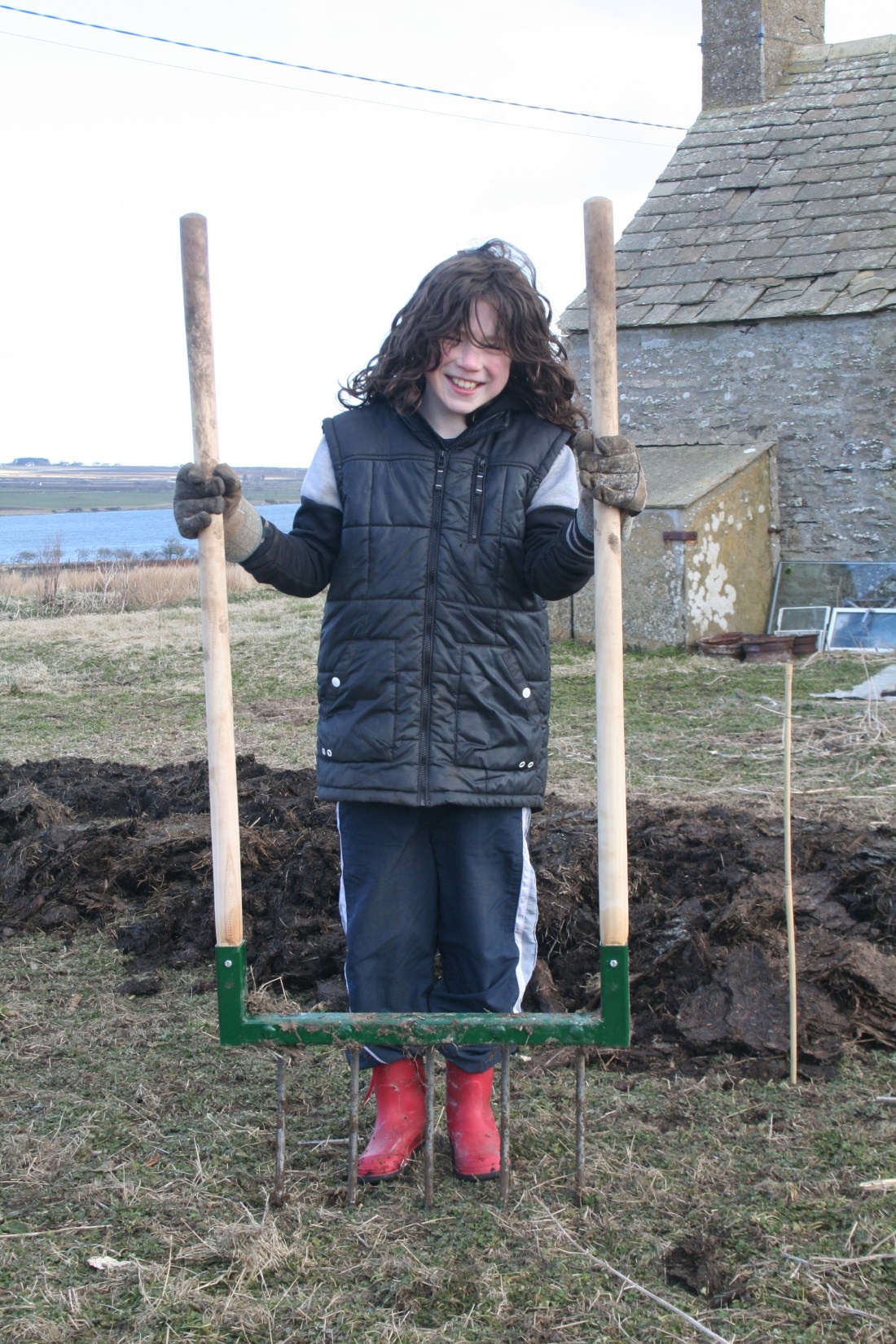
This is a two handed fork with deep tines, that are shaped into a parabolic curve rather than the straight tines on a conventional garden fork. To use you stand on the crossbar and wiggle the handles a little to force the tines into the ground. Then you lean back using your body weight to pull the handles toward you. The tines lift the soil a little but don’t destroy the structure. You lift the fork clear of the soil, move it back 8 inches or so and repeat. Keep going until you run out of bed. Our soil was so compacted we had to broadfork it in both directions, but afterwards we could really see the difference. The area that’s been worked is raised and feels springy underfoot.
Most people who use a broadfork report that after a few years of using it for bed preparation the soil is soft and loose to the full depth of the tines and it’s no longer needed.
We’ve laid out our beds to be 30 inches wide. Many of the tools developed for intensive vegetable production using minimum tillage have been designed for beds of this width and it seems sensible to future proof the layout by going with this width from the start. All of our beds will be 10 metres long so we can have all plastic mulches, weed control fabrics and fleece bed covers the same length. It also makes planning crop rotations and growing the right number of transplants simpler.
After broadforking we’ve added rock dust as a soil amendment and a broad spectrum mycorrhizal inoculant to introduce the beneficial fungi, and topped each bed with a foot of aged goat manure. Finally we’ve leveled the manure and covered each bed with black plastic sheet mulch. We’ll leave them covered until we’re ready to plant. This will warm the soil and any viable seeds in the manure will sprout and die without access to the light. The manure is full of worms. They will hopefully thrive under the mulch, aerating the soil and mixing the rock dust and manure with the aerated soil beneath. With the beds as rich in nutrients as ours are this year only heavy feeding plants will likely do well, but we’ll also be sheet mulching the remaining area and leaving it in place until next spring, by which time the creeping buttercup should be dead or nearly so. This will give us some manured beds and some less fertile, an excellent start to introducing a planned crop rotation.


